Question 78: [Inorganic > Group 7]
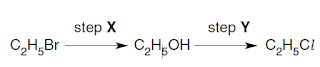
Chloroethane can be formed from bromoethane in two steps.
Which statements about these steps are correct?
1 Step X involves a nucleophilic substitution.
2 Hot aqueous sodium hydroxide is the reagent in step X.
3 Hot aqueous sodium chloride is the reagent in step Y.
Reference: Past Exam Paper - June 2003 Paper 1 Q38
Solution 78:
Answer: B.
Statement 2 is true because a chiral centre is defined as a carbon with four different substituents and a chiral centre will always display optical isomerism therefore Statement 1 is also true.
Statement 3 could be true however no condition that will prove it happening every time so cannot be true.
Question 76: [Inorganic > Group 7]
Why is the addition of concentrated sulphuric acid to solid potassium iodide unsuitable for the
preparation of hydrogen iodide?
1 Hydrogen iodide is not displaced by sulphuric acid.
2 Iodide ions are oxidised to iodine.
3 The product is contaminated by sulphur compounds.
Reference: Past Exam Paper -June 2003 Paper 1 Q36
Solution 76:
Answer: C.
Statement 1 is false because sulphuric acid is a stronger oxidizing agent than hydrogen iodide so iodine can be displaced by sulphuric acid
Statement 2 is true as H2SO4 displaces HI to H2S and I2 and H2O
Statement 3 is true as there are sulphur compounds present, H2S and SO2
Question 57: [Inorganic > Group 7]
Which gaseous hydride most readily decomposes into its elements on contact with a hot glass rod?
A ammonia
B hydrogen chloride
C hydrogen iodide
D steam
Reference: Past Exam Paper -June 2003 Paper 1 Q17
Solution 57:
Answer: C.
A cannot be because ammonia does not decompose readily.
B cannot be because hydrogen chloride is very strong the thermal stability of hydrogen halides decrease down the group and increase up the group therefore HCl is very stable
C is the answer because again the strength or thermal stability of hydrogen halides decrease down the group iodine is below both chlorine and bromine therefore its hydrogen halide thermal stability is the weakest because hydrogen iodide bond length is long and therefore less polar than HCl therefore decompose more readily , more easily.
D cannot be answer . because HI is more weaker.
Question 35:
[Inorganic > Group 7]:
The element astatine lies below
iodine in Group VII of the Periodic Table.
What will be the properties of
astatine?
1 It forms diatomic molecules which dissociate more
readily than chlorine molecules.
2 It reacts explosively with hydrogen.
3 It is a good reducing agent.
Reference: Past Exam Paper – November 2002 Paper 1 Q35
Solution 35:
Answer: D.
Astatine is a larger atom than chlorine. When it forms a diatomic
molecule it will have a greater distance between atoms thus will be weaker and
disassociate more readily, hence 1 is correct.
As the lowest halogen on the
periodic table it is the least reactive, thus will not react explosively with
hydrogen.
Since 2 is incorrect 3 must be incorrect and the only valid option is
D.
Question 17:
[Inorganic > Group 7]:
The standard enthalpy changes of
formation of HCl and HI are –92kJmol-1 and +26kJmol-1 respectively.
Which statement is most important in explaining this difference?
A Chlorine is more electronegative
than iodine.
B The activation energy for the H2/Cl2
reaction is much less than that for the H2/I2 reaction.
C The bond energy of HI is smaller
than the bond energy of HCl.
D The bond energy of I2
is smaller than the bond energy of Cl2.
Reference: Past Exam Paper – November 2002 Paper 1 Q17
Solution 17:
Answer: C.
Elimination is the best way forward. Option A is valid information but
irrelevant to the situation since electronegativity is related to
intermolecular forces yet enthalpy of formation regards intra-molecular forces,
hence eliminated.
Option B talks about activation energy which again is
relevant to the scenario however is redundant when attempting explain the
enthalpy of formation, because the activation energy only shows the energy
taken in not the energy released, hence eliminated.
Option C is correct since
it directly verifies the question. If HI has a smaller bond energy than HCl
then less energy will be released when the bond is formed, causing it to be
endothermic and hence positive.
Option D, if true, would argue against the
question since a smaller bond energy in I2 would mean less energy
required to break the bond, thus more exothermic, hence negative which is not
the case in the question.
.png)